
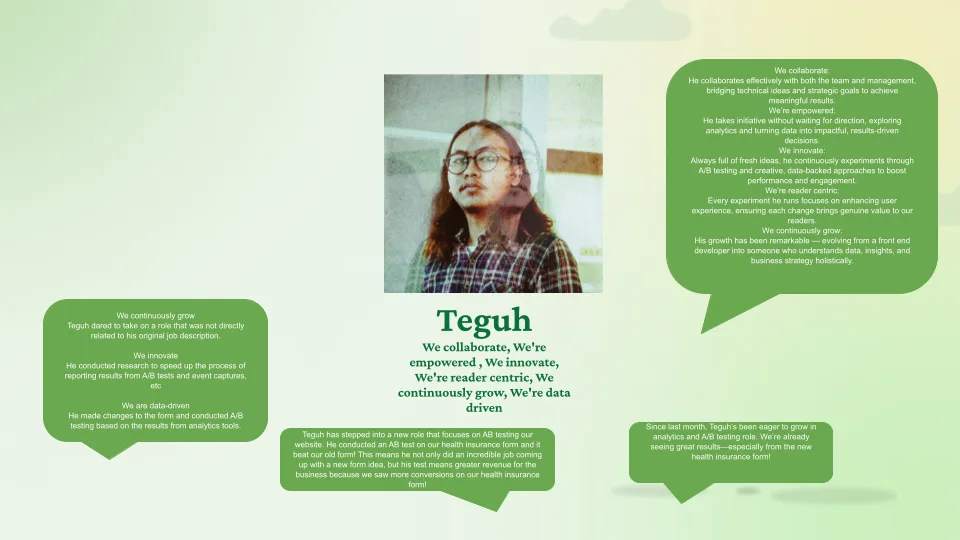
This quarter I received my company's Q3 Quarterly Values Reward — and it's probably the recognition I'm proudest of so far, because it wasn't for the code I wrote. It was for the parts of the job that aren't in my job description.
Stepping outside my lane
I'm a frontend developer. A little while back I moved into a new role: A/B testing our website — figuring out how to get more people to start our forms, and more of them to finish. Nobody handed me the role; there was a gap, I had ideas, and I went after it.
The headline result: I built and tested a whole new health-insurance signup form for our seniors-focused product, ran it against the old version across multiple experiments — and it clearly out-performed the original. You can see the live form here.
And the impact reached past the form itself:
- More people completing it — more leads through the page.
- Lower Facebook ad costs — a better-converting form makes the same ad spend work harder.
- A lift in health leads from our newsletter, too.
- Net effect: real, measurable revenue for the business.
A frontend change, measured and proven, that moved numbers that actually matter.
What it actually took
It wasn't just "make a nicer form." The work was a loop:
- Read the data first. Dig into analytics, find where people drop off, form a hypothesis about why.
- Design the experiment. Build the variant, set up the A/B test, define what "better" means before running it.
- Make reporting faster. I built tooling and tightened the process for capturing events and reporting A/B results, so insights came back quicker and decisions didn't stall.
- Let the numbers decide. Ship the winner, keep what works, drop what doesn't.
The part that meant the most
The award maps to our company values, and the ones that stuck with me weren't about output — they were about how I showed up:
- Empowered — taking initiative without waiting to be told.
- Data-driven — backing changes with evidence, not opinion.
- Reader-centric — every experiment aimed at genuinely improving the experience for our users, not just nudging a metric.
- Continuously growing — evolving from "the frontend guy" into someone who thinks about data, insights, and business strategy too.
That last one is the one I care about. I still love the craft of building interfaces — but pairing it with experimentation and a real understanding of the business has made me a far more useful engineer.
It wasn't a solo effort, either. I worked closely with a great team lead and the wider dev & design team — plenty of the credit is theirs.
What I'm taking from it
Output is easy to see; outcomes are what count. Shipping a feature is a start — knowing whether it actually helped is the job. I'm leaning further into that: frontend craft and the data to prove it's working. More to come.