I picked up my second Quarterly Values Reward — Q2 2026 this time, for the work I've been doing on our AI Innovation Team. The last one was for stepping out of frontend into A/B testing and data. This one is for something different, and honestly more surprising to me: being the person who makes other people's ideas buildable.
The award, and what it was for
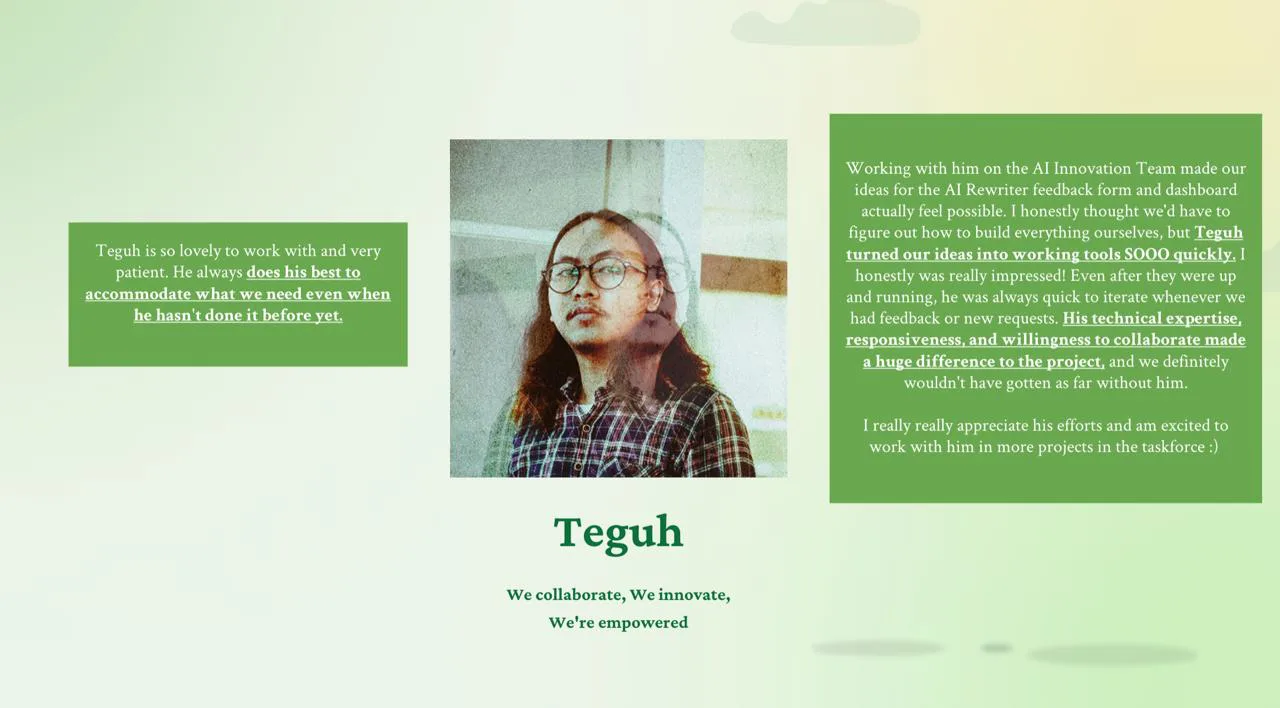
The values it maps to are We collaborate, We innovate, We're empowered — and the feedback that came with it says the thing better than I could:
Working with him on the AI Innovation Team made our ideas for the AI Rewriter feedback form and dashboard actually feel possible. I honestly thought we'd have to figure out how to build everything ourselves, but Teguh turned our ideas into working tools SOOO quickly.
And from someone else on the team:
Teguh is so lovely to work with and very patient. He always does his best to accommodate what we need even when he hasn't done it before yet.
"I thought we'd have to build everything ourselves"
That line is the one I keep coming back to.
The taskforce is mostly not engineers. They had a clear idea of what they needed — a feedback form for our AI Rewriter, and a dashboard to actually read what came back — and a quiet assumption that wanting it and having it were separated by a mountain of work someone else wasn't going to do.
The gap wasn't imagination. It was the distance between an idea and something you can click. My whole contribution was shortening that distance until people stopped self-censoring their ideas.
That's the part I'd underrated for most of my career. I used to measure my value in what I built. On a cross-functional team, a lot of it turns out to be in what other people are now willing to propose, because they've learned the build won't be the bottleneck.
Shipping fast keeps the feedback loop alive
Speed mattered here for a specific reason — not because fast is impressive, but because a tool nobody's used yet generates no useful feedback. The sooner something real is in front of the team, the sooner the requests get concrete:
- Rough version out early, so the conversation is about a real screen instead of a hypothetical one.
- Iterate the moment feedback lands — the reward feedback singles out "always quick to iterate whenever we had feedback or new requests," and that responsiveness is the feature.
- Keep the tooling boring. Most of this rides on Airtable, automations, and small focused builds — the same approach behind the writers performance dashboard and the leave portal. Boring infrastructure means changes take minutes, not sprints.
The stack being unglamorous is the point. Nothing here needed a new service or a deploy pipeline. It needed to exist this week.
"Even when he hasn't done it before yet"
The other line I'm oddly proud of. Not "he's an expert in this," but "he'll have a go at it."
A lot of internal tooling sits in the space where nobody's the expert — some Airtable, some automation, some API you've never touched, a bit of AI plumbing. If the answer to "can we do X?" is only ever yes when someone's done X before, most good ideas die on the spot. Being genuinely willing to work in the unfamiliar is a skill, and it's one I've had to practise, not one I started with.
What I'm taking from it
Two awards, two different lessons. The first was outcomes over output — ship the thing, then prove it moved a number. This one is quieter:
Being the person who makes things feel possible compounds. Every idea you turn into something clickable makes the next idea more likely to get raised at all. The tools I built last quarter matter less than the fact the taskforce now brings me things they'd previously have shelved.
Still a frontend developer. Just increasingly one whose job is to shorten the distance between "wouldn't it be good if…" and something on a screen.